Chicks need added heat for about their first six weeks: 95°F in week one, dropping 5 degrees a week until the brooder is at room temperature. By then most standard breeds have the feathers to keep themselves warm.
Brooder temperature by week
| Age | Temperature at chick level |
|---|---|
| Week 1 | 95°F |
| Week 2 | 90°F |
| Week 3 | 85°F |
| Week 4 | 80°F |
| Week 5 | 75°F |
| Week 6 | 70°F, or room temperature |
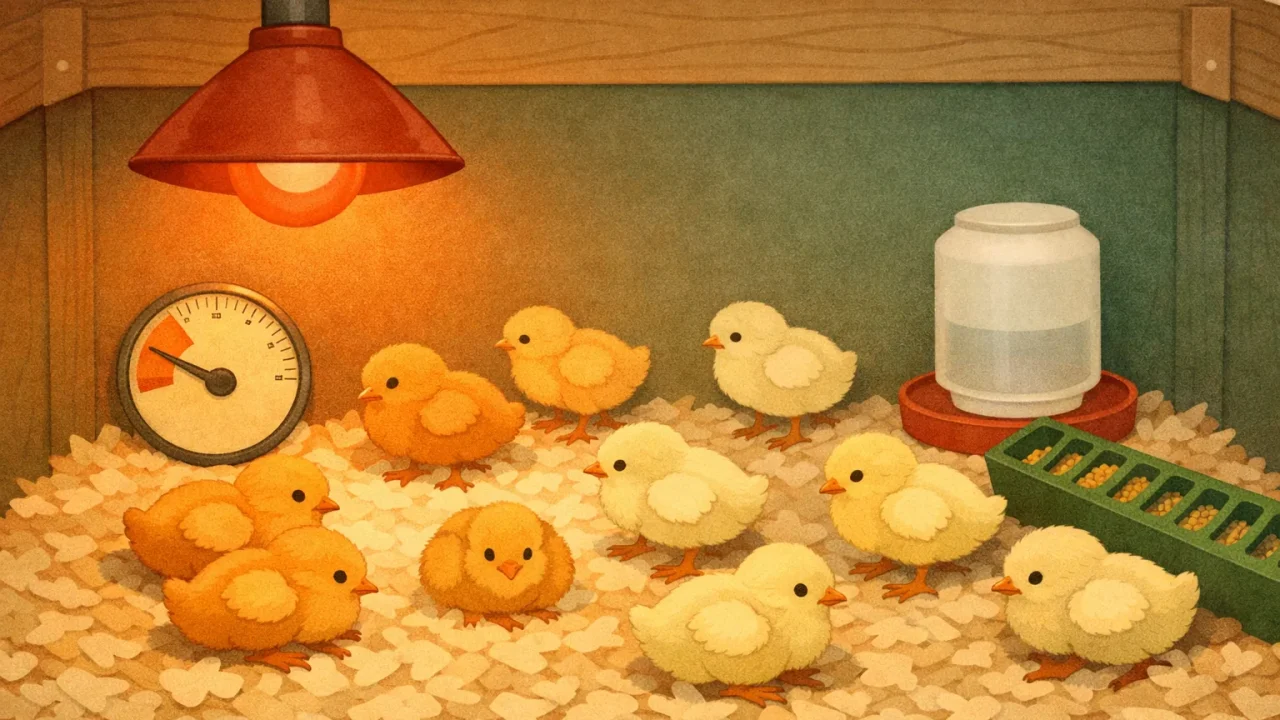
Measure at the height of the chicks’ backs, at the warm end of the brooder, not up at the lamp or on the far wall.
Give them a warm end and a cool end
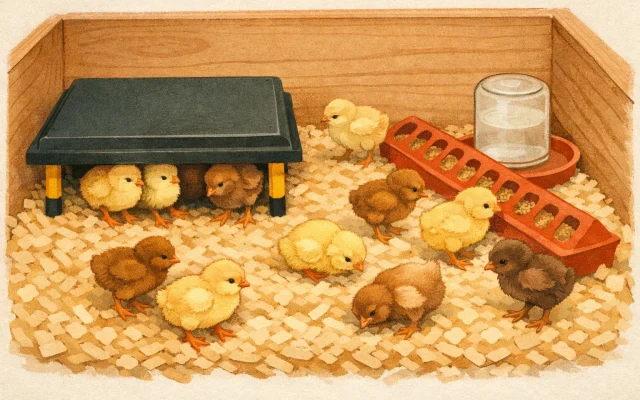
Put the heat at one end of the brooder and the feed and water toward the other. A chick that can walk away from the heat will regulate its own temperature better than any thermostat. If the whole brooder is the same temperature, it is too small or the heat is too central.
Read the chicks, not just the thermometer
| What you see | What it means | What to do |
|---|---|---|
| Piled under the heat, cheeping loudly | Too cold | Lower the heat source or check for a draft |
| Pressed to the walls, panting, wings held out | Too hot | Raise the heat source or reduce its output |
| Bunched on one side | A draft | Block it or move the brooder |
| Spread out, eating, drinking, napping | Just right | Leave it alone |
When can the heat come off?
When the chicks are feathered and the brooder temperature has stepped down to match the room, usually around week six. In a warm room that can come sooner, since the room does part of the work; in an unheated garage in early spring it will take the full six weeks or longer. Bantams and slow-feathering breeds often need extra time.
Heat lamp or heat plate?
A heat lamp warms the air and is easy to adjust by raising or lowering it, but it is a fire risk and lights the brooder all night. If you use one, secure it as if it were permanent, keep it clear of bedding and plug it straight into an outlet, not an extension cord. A heat plate warms chicks that stand under it, much as a hen would, uses less power and does not light the room. With a plate, the week-by-week air temperatures above matter less; follow the maker’s height settings and watch how the chicks behave.
Whichever you choose, run it for a day before the chicks arrive. Full setup steps are in how to raise baby chicks.
Sources
- Penn State Extension: Brooding of Domestic Fowl
- Oregon State University Extension: Raising Baby Chicks
- University of Maine Cooperative Extension: Giving Chicks a Good Start (Bulletin 2219)
- North Dakota State University Extension: Beginner’s Guide to Raising Chickens
- North Dakota State University Extension: Take Precautions When Using Heat Lamps
- Cornell Small Farms Program: Managing Risk, Using Heat Lamps on the Farm